
Accessible bathroom renovations in Canberra
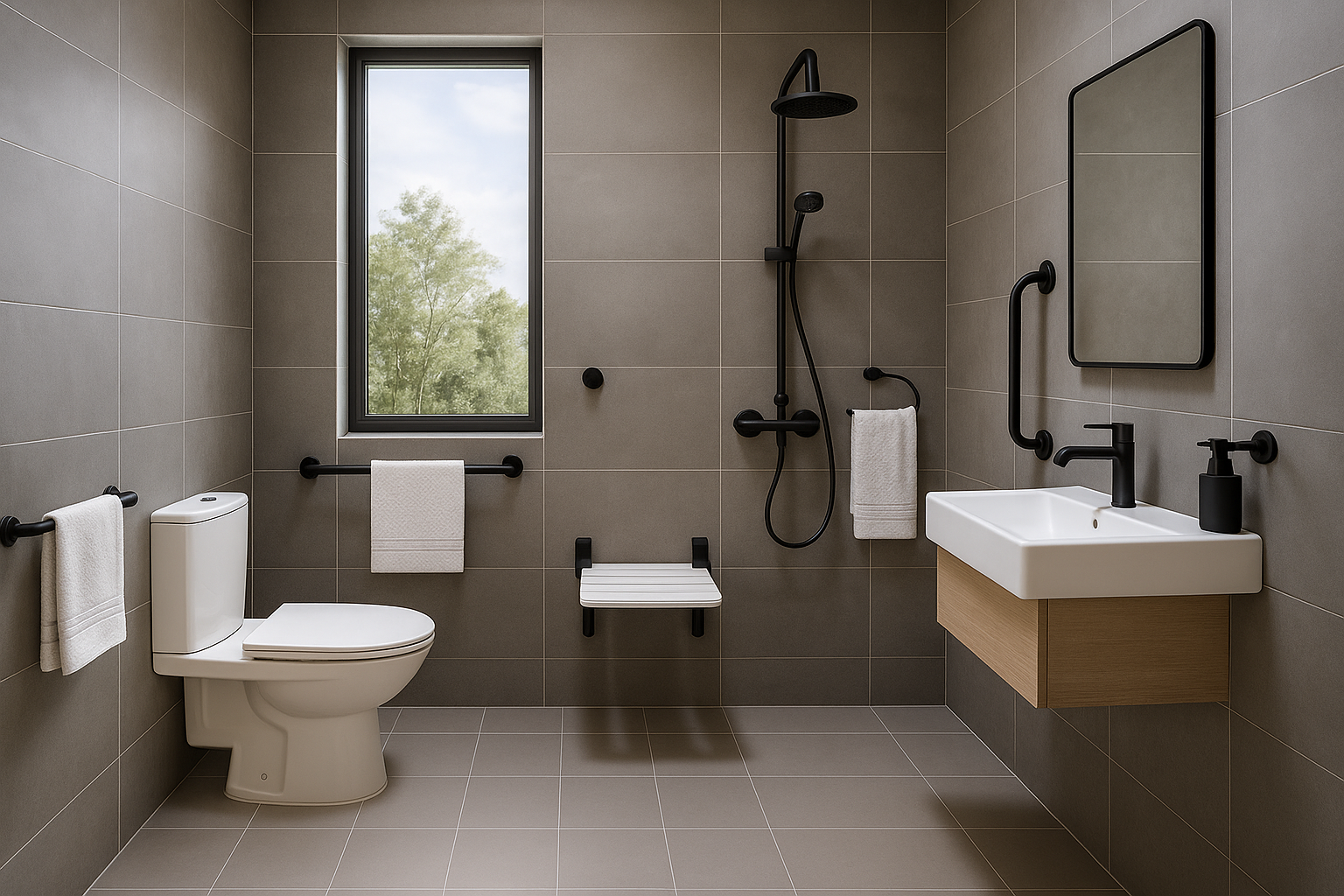
A bathroom should be safe, functional, and comfortable for everyone who uses it, at every stage of life. Whether you are renovating to support a family member living with disability, preparing your home for the years ahead, or modifying a property to meet NDIS or occupational therapist recommendations, The Bathroom Co. has the expertise to deliver an accessible bathroom that works precisely as it should.
With over 30 years of experience renovating Canberra bathrooms and a dedicated accessible design capability, our team understands both the technical requirements and the human reality of this work. The result is a space that meets Australian Standards, attracts funding where eligible, and above all helps the person using it live more independently.
Accessibility and style are not mutually exclusive. One of the most persistent misconceptions about accessible bathroom design is that compliance with accessibility standards means accepting a clinical, institutional aesthetic. This simply is not true. The features that make a bathroom accessible, hobless showers, lever tapware, non-slip flooring, generous circulation space, are also the hallmarks of contemporary, design-led bathrooms.
The Bathroom Co. approaches every accessible renovation with the same design rigour we bring to our full renovation projects. Your accessible bathroom will look and feel like a considered, modern space, not an afterthought. We work with you, your occupational therapist, and where relevant your NDIS planner to produce a result that serves its purpose beautifully.
Essential features of a fully accessible bathroom
The features below are drawn from Australian Standard AS 1428.1-2021 (Design for Access and Mobility) and reflect best practice in accessible bathroom design. Not every feature is appropriate for every project, the right combination depends on the individual’s needs, the property layout, and the funding available.
Hobless (zero-threshold) shower: A shower with no step or raised lip to navigate is the single most important feature in most accessible bathrooms. The minimum compliant shower size is 1,160mm × 1,100mm under AS 1428.1, though 1,500mm × 1,500mm is recommended for wheelchair users. The floor gradient (1:60 to 1:80) directs water to a linear drain without creating a trip hazard. A fold-down shower seat and an adjustable shower head on a flexible hose complete the setup.
Grab rails: Correctly specified and installed grab rails are among the most cost-effective safety modifications available. Rails must be 30 to 40mm in diameter with 50 to 60mm clearance from the wall, provide at least 1,100 Newtons of load resistance, and contrast at least 30% in luminance from surrounding surfaces. The wall behind them must be reinforced — either with structural noggings, plywood backing, or by positioning rails over existing studs. We install horizontal, vertical, L-shaped, and fold-down configurations as required.
Non-slip flooring: All wet area flooring must achieve at least a P4 rating under AS 4586-2013 (Slip Resistance Classification); P5 is recommended for bathrooms used by people with limited mobility. Textured porcelain tiles, small-format tiles with increased grout coverage, and specialist vinyl all meet this standard. We do not use highly polished or large-format glazed tiles in accessible bathrooms.
Wider doorways: A clear door opening of at least 850mm is required by AS 1428.1 for wheelchair access; 920mm or wider is recommended. Sliding or barn-style doors eliminate the arc of a hinged door and maximise usable floor space. The force required to open the door should not exceed 20 Newtons.
Comfort-height toilet: A toilet seat height of 460 to 480mm (compared with the standard 390 to 420mm) makes sitting and standing significantly easier for people with limited lower-body strength or joint problems. The toilet must be positioned with adequate transfer space and must contrast with surrounding surfaces for visibility.
Lever tapware and accessible fittings: Lever handles require far less grip strength and dexterity than round knobs or cross-head taps, making them accessible to people with arthritis, neurological conditions, or reduced hand strength. Thermostatic mixing valves (TMVs) set the water temperature at a safe maximum, protecting against scalding, particularly important where the user has reduced sensation.
Additional accessibility features
Wall-hung vanities at accessible heights (720 to 780mm) with knee clearance for wheelchair use
Mirror with bottom edge below 900mm from floor
Motion-activated or rocker-style lighting switches
Emergency call or pull-cord system
Outward-opening or sliding door to ensure access if a person falls against the door
Australian Standards your renovation must meet
Accessible bathrooms in Australia are governed by a suite of Australian Standards and building codes. The Bathroom Co. designs and constructs all accessible renovations to full compliance, and provides certification at handover.
NDIS bathroom modifications: how funding works in Canberra
The National Disability Insurance Scheme (NDIS) funds bathroom modifications for eligible participants as part of the Home Modifications support category. Understanding how this funding works will help you make the most of your plan and avoid unnecessary delays.
The three categories of NDIS home modification
NDIS home modifications fall into three categories based on complexity and cost:
Simple home adaptations: Low-cost items that can be implemented quickly. Examples include grab rails, mounted shower chairs, and lever handles. These can often be approved without a formal OT report, though an OT should still advise on placement.
Minor modifications (under $20,000): Category A covers non-structural modifications under $10,000; Category B covers modifications from $10,000 to $20,000. Both require an OT assessment. The NDIS provides set budget amounts based on assessed market costs.
Complex modifications (over $20,000): Full accessible bathroom renovations typically fall here. These require two builder quotes, a detailed OT assessment and report, and in many cases input from a building construction practitioner. The NDIA reviews all evidence before approving funding.
The NDIS modification process, step by step
Understanding the process helps you plan your timeline. Complex modifications in particular require patience, but the outcome is a fully funded bathroom designed specifically for your needs. The OT certifies that the completed work meets their recommendations. The Bathroom Co. provides full compliance documentation at handover.
The Bathroom Co. works closely with occupational therapists, NDIS planners, and support coordinators throughout the Canberra region. We understand the documentation requirements and provide NDIS-compliant quoting and reporting as standard.
Other funding pathways: Support at Home, DVA, Aged Care, and private options NDIS is not the only funding pathway for accessible bathroom modifications. Depending on your circumstances, one or more of the following may also apply:
Support at Home: Assistive Technology and Home Modifications (AT-HM) Scheme
Aged Care: Eligible individuals may access funding through the Commonwealth Home Support Programme (CHSP) or Home Care Packages (HCP)
Department of Veterans & Affairs (DVA): Rehabilitation Appliances Program
Private funding and combined funding arrangements
Working with occupational therapists
Occupational therapists play a central role in accessible bathroom projects, both as the clinical authority whose recommendations drive the design, and as the certifier of the completed work. The Bathroom Co. has established working relationships with experienced home modification OTs across the Canberra region and can facilitate introductions where needed.
For NDIS complex modifications, the OT must have post-graduate training and senior clinician experience in home modifications. For Support at Home and DVA modifications, OT requirements are similar but administered through different agencies. We will guide you through the requirements relevant to your funding pathway.
How much does an accessible bathroom renovation cost in Canberra?
Costs vary significantly depending on the scope of modifications, the condition of the existing bathroom, and whether structural changes (such as doorway widening) are required.
All The Bathroom Co. accessible bathroom projects include a 10-year workmanship warranty, full compliance certification, and detailed documentation suitable for NDIS, DVA, and My Aged Care funding acquittal.
Our accessible renovation process
Stage & what it involves:
Consultation: We’ll visit your home to understand your needs, review the space, and discuss your funding situation.
OT and design coordination: We work with your OT to align the renovation scope with their assessment and recommendations.
Proposal and documentation: Detailed quote and NDIS/DVA-compliant documentation prepared for funding submission.
Approval and permits: ACTPLA permits lodged, NDIA or funding body approval obtained before work commences.
Renovation: Full accessible renovation completed by our licensed team, with staged inspections throughout.
Handover: OT final inspection, compliance certification, warranty documentation issued. 10-year warranty commences.
Ready to get started?
Understanding what’s included in your bathroom renovation is the first step toward a stress-free project. At The Bathroom Co., we handle every detail from design through to handover — so you can focus on the exciting part: choosing a bathroom you’ll love. Book your free consultation today. With 30+ years of experience renovating Canberra homes and a 10-year warranty on every project, you’re in safe hands.
Frequently Asked Questions
-
The NDIS can fund a wide range of bathroom modifications under the Home Modifications support category, including hobless showers, grab rails, non-slip flooring, doorway widening, accessible toilet and basin configurations, and thermostatic mixing valves. Purely cosmetic upgrades (such as premium tiles chosen for aesthetic reasons alone) are generally not funded, though participants can self-fund any upgrades beyond the functional specification.
-
For NDIS complex modifications (over $20,000), an OT assessment is mandatory. For minor modifications, it is strongly recommended. For DVA and Support at Home modifications, OT involvement is also required as part of the funding approval pathway. An OT assessment ensures the modifications are clinically appropriate for your specific needs — and provides the documentation necessary for funding approval.
-
AS 1428.1-2021 specifies a minimum clear opening width of 850mm for doorways in accessible designs, with 920mm or wider recommended to provide comfortable access for powered wheelchairs and other mobility aids. If your existing doorway is narrower, widening is typically a non-structural change costing $300 to $1,500, though some older properties may require structural work.
-
Start by contacting your NDIS planner, Local Area Coordinator (LAC), or Support Coordinator to confirm that Home Modifications funding is included in your current NDIS plan. You will then need to engage a qualified OT to conduct a home modifications assessment. The OT report, along with builder quotes, is submitted to the NDIA for approval. The Bathroom Co. can assist with the quoting documentation and advise on the timeline for your specific project.
-
NDIS funding covers the cost of modifications to the functional specification approved by the NDIA. If you would like to upgrade finishes beyond the standard specification. For example, choosing a premium tile rather than the standard specification, you can self-fund the difference. We structure our quotes to clearly separate the funded and privately funded components.